
Current research
Post-Platform Urbanism
AI and Housing Platforms in Berlin
FUNDING
DFG (German Research Foundation)
DURATION
3 (+2) years
Principle Investigator
Dr. Niloufar Vadiati
Initial Concept
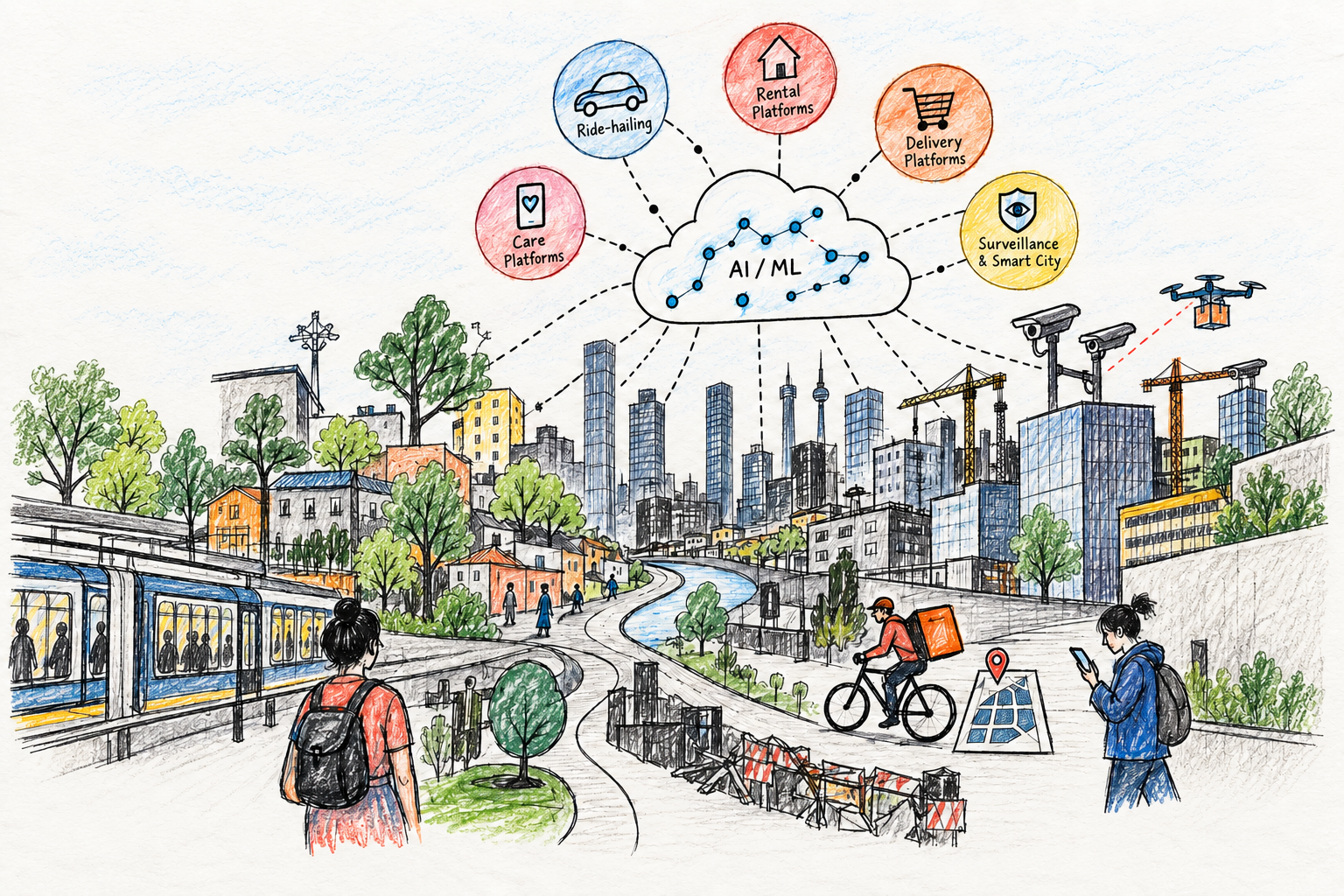
This research examines the transformative role of digital and post-digital platforms in Berlin's urban rental housing landscape,
with a focus on their disruptive, infrastructural, and speculative dimensions. While digital platforms have introduced new
possibilities for accessing housing, they have also exacerbated affordability issues, gentrification, and socio-spatial inequalities.
Moreover, emerging post-platform systems, powered by AI and automation, promise enhanced efficiency in housing processes
but raise concerns around further marginalisation.
Former Research
PLANETARY HEALTH, TECH AND URBANISATION
SUMMARY
Planetary health does not emerge from isolated human subjects at a global scale; rather, it unfolds as a relational process sustained through ecological systems and intra-species entanglements.
Urbanisation has become an increasingly dominant force in planetary health, reconfiguring human and more-than-human habitation through living infrastructures—air, water, food systems, as well as infrastructures of care.
At the same time, planetary health is becoming deeply entangled with computation, not only as a set of tools but also as an ideology:
As tools, digital twins, environmental sensing, modelling, and generative artificial intelligence are mobilised to anticipate crises, manage uncertainty, and render life on the planet ‘resilient’. As ideology, digital technology has opened new terrains of planetary experimentation and futuring: from the search for alternative planets for human habitation to ambitious—and often surreal—biotechnological projects conducted in enclosed or de-urbanised territories, such as attempts to ‘cure death’.
Through these processes, planetary health is unprecedentedly shaped by computationalisation alongside ongoing dynamics of (de)urbanisation, including ecological degradation and the erosion of living and care infrastructures.
In this context, the central research question is how urban–technological assemblages sustain—or undermine—the conditions of collective and more-than-human health across planetary space.

GRASSROOTS DIGITAL URBANISM
RESHAPING URBAN SPACE AND GOVERNANCE IN BERLIN

FUNDING
DFG* (German Research Foundation), Walter Benjamin Programs
DURATION
2 years
Principle Investigator
Dr. Niloufar Vadiati
THE INITIAL CONCEPT
At a time when the state-corporation version of the smart city seems to be far from a panacea for cities, there is a need to think beyond critiques of techno-capitalist developments and to imagine alternatives.
Among the recent urban experimental collectives and organisations, there is an increasingly strong aspiration to imagine new digital urbanism possibilities representing those who refuse to be excluded from the 'backend' of smart cities proiects and avoid being kept 'dumb'. The aim of the project is discursive analysis and empirical study on the role of grassroots digital urbanism in changing the production of space and reconfiguration of governance in the city of Berlin.
Project PUBLICATIONS
Vadiati, N., Chiappini, L., & Bangratz, M. (2025). (En) coding care into digital urbanism: Vignettes of collective practices. Digital Geography and Society, 8, 100120.
Vadiati, N. (2022). Alternatives to smart cities: A call for consideration of grassroots digital urbanism. Digital Geography and Society, 3, 100030.
-Vadiati, N. (2026). Grassroots speculation in computational cities: Practicing hope around Berlin’s digital turn. Urban Studies, Special Issue on Ordinary Urban Speculation.
Vadiati, N., & Voigt, M. L. (2024). Refusal and the Computational City – From (de)coding the machine to (en)coding care [Call for papers]. Digital Geography and Society. https://www.sciencedirect.com/special-issue/1002PJ5FCBT
PROJECTPARTNERS
HafenCity University Hamburg, Helmut Schmidt University, DFS Deutsche Flugsicherung GmbH, Dronig GmbH, HHLA Sky GmbH, Technical University of Hamburg, Ministry of Economics and Innovation of the Free and Hanseatic City of Hamburg
Urban AiR MOBILITY in Hamburg

FUNDED BY
Funded by the German Federal Ministry of Digitalisation and Transport (BMDV).
THE CONCEPT
How will UAM (Urban Air Mobility) be integrated into the current mobility landscape? What are the requirement and challenges of urbanizing the AAM (Advanced Air Mobility)? In regard to air mobility, what does social acceptance even mean?
These are questions that we have addressed in German National Urban Air Mobility project, LUV and in UAM-Social Acceptance Think Tank at Windrove Hamburg Aviation.
LUV - NATIONAL IMPLEMENTATION OF THE U-SPACE REGULATION FOR GERMANY
Project Publication
Under Review by Progress in Economic Geography: Legitimation strategies in emerging ecosystems: The case of advanced air mobility in Hamburg
LEGACY OF MEGA PROJECTS / EVENTS/ Olympic Games
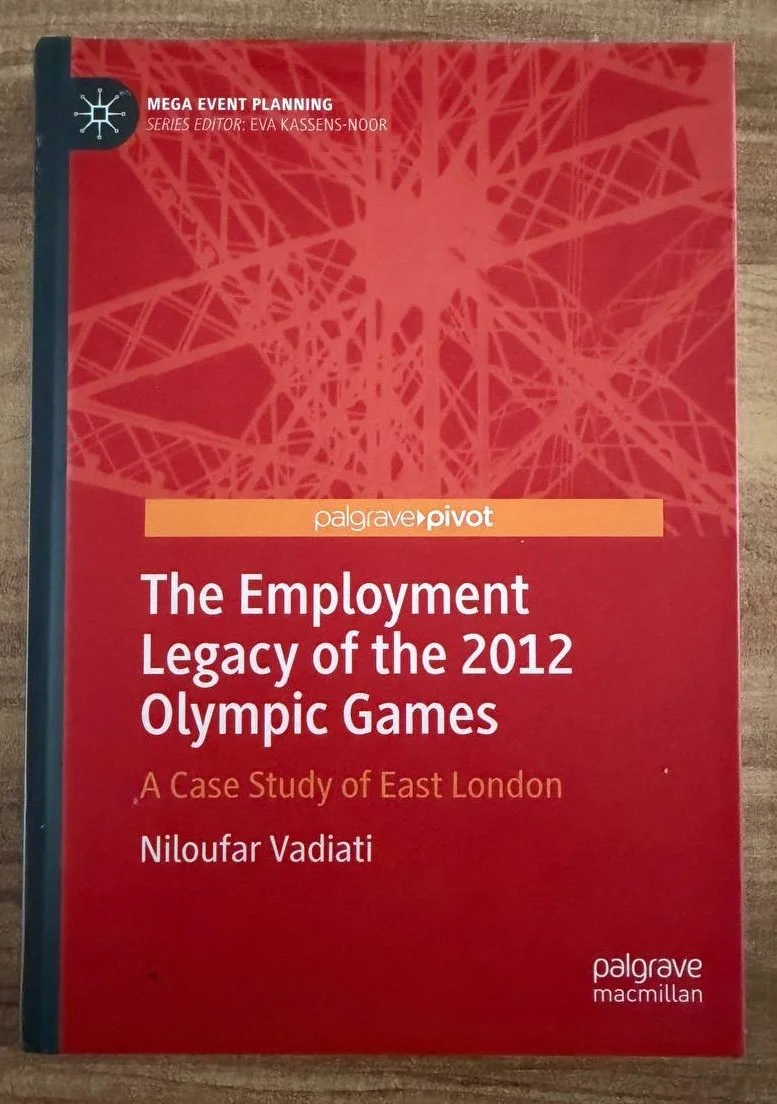
It is based on my four years of PhD study questioning the socio-economic effects of the London Olympic Games 2012 on the Local East Londoners. The focus of the research has been on labour market, examining the interactions between London 2012 as a massive employer, the employment legacy agenda of the London 2012 and the local East Londoners as the labour supply for the Games. The findings of this research have also several significant suggestions on urban governance at the time of hosting a Mega-event in a host city.
Book PUBLICATION
Vadiati, V. (2020). The employment legacy of the 2012 olympic games. Springer Singapore.